 Nonogram World
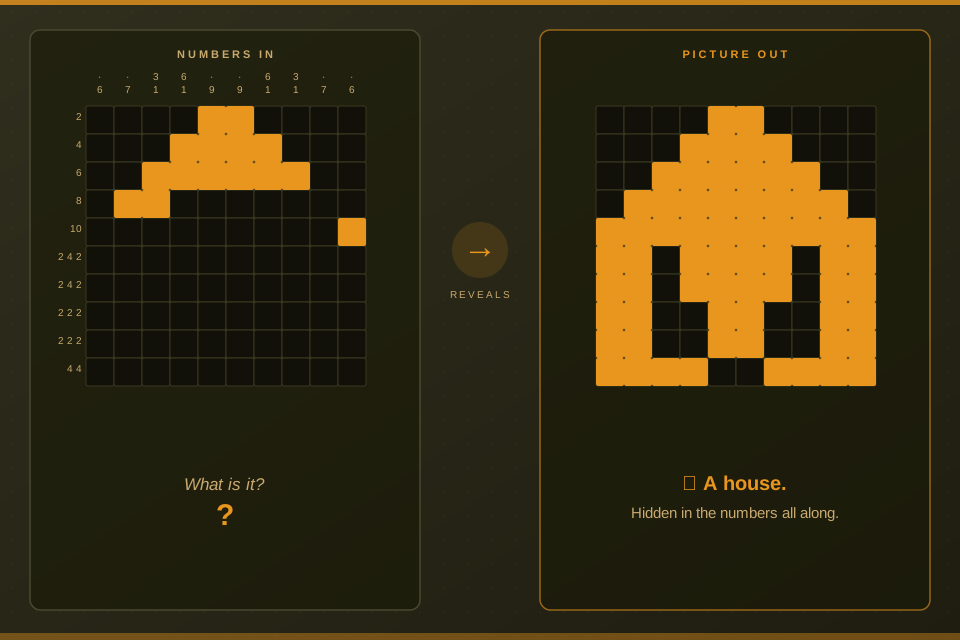
A nonogram is a logic puzzle played on a grid. Numbers printed along the rows and columns tell you which cells to fill in. Solve it correctly, and a hidden picture emerges — you never know what you're drawing until the very last move.
That reveal moment is what makes nonograms addictive.
How Nonograms Work
A nonogram grid looks like a blank spreadsheet. Along the top of each column and to the left of each row, you'll see a sequence of numbers. These numbers are your clues.
Each number tells you: in this row (or column), there is a run of filled cells exactly this long. Multiple numbers mean multiple separate runs — each separated by at least one empty cell.
The clue 3 1 in a row means: three filled cells in a row, then at least one gap, then one more filled cell. Your job is to figure out exactly where each run sits — using pure logic, no guessing.
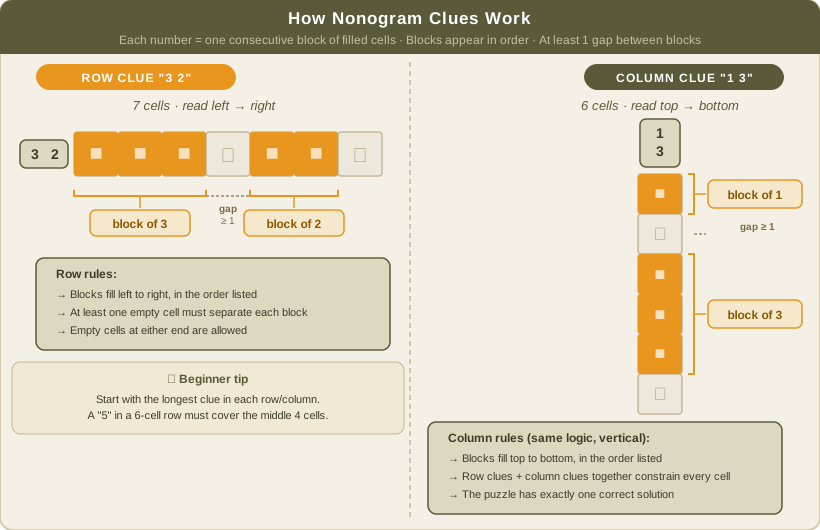
Row clues are read left to right; column clues top to bottom. Blocks appear in order with at least one empty cell between them.
Nonogram Rules: How to Read the Clues
- Each number = one consecutive block of filled cells. A clue of "4" means exactly four cells in a row, all touching.
- Multiple numbers appear in order. Left-to-right for rows; top-to-bottom for columns.
- At least one empty cell separates each block. Two blocks can never be adjacent.
- Every cell is either filled or empty. No partial fills, no shading gradients.
That's it. The nonogram puzzle is solved when every cell is correctly determined. No scores, no timers, no luck — just logic applied to clues.
Why the Reveal Is the Point
Most puzzles give you the goal upfront — in a crossword you know you're filling in words; in sudoku you know you need the numbers 1–9. Nonograms are different.
You start solving with nothing but a grid and a set of numbers. You make logical deductions. Cells fill in one by one. And somewhere around 70% of the way through, you realize what you're looking at.
A cat. A rocket. A fish. A cityscape.
The picture was hiding in the numbers all along. That reveal — that "oh!" moment — is what keeps solvers coming back. You didn't just complete a nonogram puzzle; you uncovered an image that was always there, waiting in the logic. No other puzzle format replicates that feeling.
How to Solve a Nonogram: The Overlap Technique
Knowing the rules is easy. Knowing where to begin is the real skill.
The most useful technique for beginners is called the overlap method. The idea: a long clue in a short row has very little room to move. If you have a clue of 5 in a row of just 6 cells, the block must occupy either cells 1–5 or cells 2–6. Either way, cells 2–5 are definitely filled — you can shade them immediately, without knowing the exact position.
The longer the clue relative to the row, the more overlap there is. A clue of 7 in a 7-cell row means every single cell is filled. Start with these high-certainty deductions, then work outward.
From there, you cross-reference. When a cell gets shaded in a row, check that cell's column: does the column clue become more constrained? Usually it does. You bounce between rows and columns, tightening the logic, until every cell is determined.
Well-designed nonograms never require guessing. If you find yourself stuck, there's almost always a constraint you missed — not a reason to trial-and-error.
Other Names: Picross, Griddler, Hanjie
The nonogram puzzle goes by many names depending on where you encounter it:
Nintendo's trademarked name, popularized by the Game Boy series in the 1990s
Name popularized by UK newspaper puzzle sections; large community at griddlers.net
Common in UK puzzle magazines such as Puzzler and Take a Break
Sometimes used for the logic variant — not to be confused with children's coloring kits
They're all the same nonogram puzzle. Learn one format, know them all.
A Brief History of Nonogram Puzzles
Nonograms were independently invented by two people in 1987: Non Ishida, a Japanese graphics editor who created picture-logic puzzles as a hobby, and Tetsuya Nishio, a professional puzzle constructor. The name "nonogram" comes from Non Ishida's first name. The format was published in Japan under the name "お絵かきロジック" (picture logic) and spread globally through puzzle magazines.
Nintendo brought the format to mainstream audiences through the Picross series starting in 1995. For many players — especially in North America — Picross on the Game Boy or Nintendo DS was their first encounter with picture-logic puzzles. The format spread through magazines across the UK and Japan throughout the late 1990s and 2000s.
Today, nonograms are solved online by millions of players worldwide. The move to browsers was natural: no physical newspaper required, no cartridge needed. Large libraries of user-created puzzles can be shared freely, and the format works perfectly on any screen.
What Size Nonogram Should a Beginner Start With?
| Grid Size | Time | Level | Notes |
|---|---|---|---|
| 5×5 or 10×10 | 2–5 min | Easy | Logic clicks fast. Ideal for learning nonogram rules. |
| 15×15 | 10–20 min | Easy–Med | The sweet spot for a satisfying session. |
| 25×25 | 20–45 min | Medium | More hypotheses to track. Rewarding picture reveal. |
| 80×80 colored | 1–4 hrs | Advanced | The deep end. Extremely satisfying to complete. |
If you've never solved a nonogram before, start with 10×10 black-and-white puzzles. The technique will click after your second or third attempt. Jumping straight to a large grid leads to frustration — not because the puzzle is unfair, but because the mechanics feel foreign before they feel natural.
Black-and-White vs. Colored Nonograms
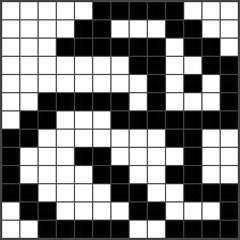
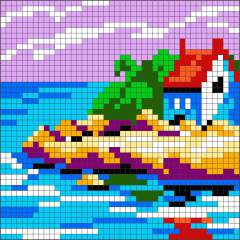
Left: classic black-and-white nonogram — one fill color, silhouette image, beginner-friendly. Right: colored nonogram — each clue number carries a color, producing full-color pictures with more complex logic.
Classic nonograms fill cells with a single color — black — against a white background. The resulting image is silhouette-style: simple, clean, and immediately recognizable.
Colored nonograms (also called color nonograms or multi-color Picross) add a new layer: each number in the clue also carries a color. Instead of "3 filled cells," you have "3 red cells" or "2 blue cells." You need to determine both the position and the color of each block.
This added dimension changes the puzzle significantly. In black-and-white nonograms, any two adjacent blocks must have a gap between them. In colored nonograms, two blocks of different colors can touch — no gap required. This creates new solving techniques and new ways to get stuck.
The payoff is real: colored nonograms produce detailed, photographic-quality images. They're the advanced tier, but once you've built the skill on black-and-white puzzles, they become the most rewarding format available.
Why Play Nonograms Online: Browser vs. Mobile App
If you search for nonograms in a mobile app store, you'll find dozens of options. Most share the same problems: ads between every puzzle, a "lives" system that punishes mistakes, premium currency to unlock larger grids, and time pressure that turns a relaxing puzzle into a stress test.
Playing nonograms online in a browser strips all of that away. You open a page, pick a puzzle, and solve it. No account required. No timers. No penalty for filling in the wrong cell — just erase it and keep going. When you finish, you pick another puzzle.
Screen size also matters. A 25×25 nonogram on a phone screen is cramped. On a laptop or desktop monitor, the same grid is comfortable and readable. Colored nonograms in particular benefit from screen space — small cells make it hard to distinguish similar shades.
What Makes a Great Nonogram Puzzle
Not all nonogram puzzles are created equal. A well-designed puzzle has three defining qualities.
First, it has exactly one valid solution. A nonogram with multiple possible solutions is a design flaw — the solver has no way of knowing which answer is correct. Good constructors verify puzzles computationally before publishing.
Second, it never requires guessing. Every cell should be logically deducible from the clues, given patience and cross-referencing. If the only path forward is to assume a cell is filled and backtrack if wrong, the puzzle is broken. Reputable libraries reject puzzles that require trial-and-error.
Third, the revealed image should clearly look like what it's supposed to be. A well-constructed 10×10 cat nonogram should be immediately recognizable as a cat, not an ambiguous blob. Skilled constructors work backwards: design the image first, generate the clues, then verify uniqueness and readability.
When all three qualities come together, solving feels effortless even when it's challenging — because the logic always feels fair.
Nonograms and Mental Focus
Nonograms occupy a particular mental space: demanding enough to require active concentration, but not so open-ended that they produce anxiety. There's no creative pressure, no blank-page problem. There's a grid, there are clues, and there is one correct answer — you just have to find it.
This makes solving nonogram puzzles particularly effective for what some describe as "active rest" — a mental state where you're fully engaged but not stressed. Many solvers report that the focused attention required clears their mind in the same way a walk does. The logic channel runs at full capacity; other worries don't fit.
There's also a distinct spatial reasoning element. You're not retrieving words from memory or performing arithmetic. You're constructing a spatial map, tracking constraints across rows and columns simultaneously. Researchers have linked this type of solving to maintained cognitive flexibility, though the science on puzzle-specific cognitive benefits is still developing.
What is certain: nonograms are meditative without being mindless. That combination is rare, and it explains why the format has sustained devoted communities for almost four decades.
Frequently Asked Questions About Nonograms
Try a Nonogram Now — Free, No Account Needed
The fastest way to understand nonograms is to solve one. Pick an easy 10×10 and see if the reveal moment hooks you.
Play Free Nonograms →